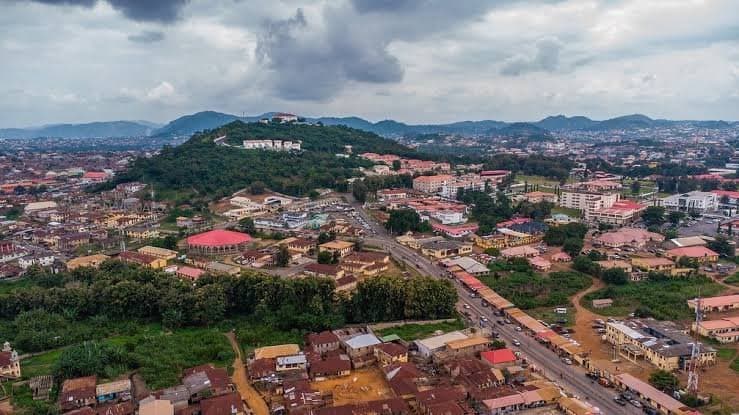
Ekiti State, fondly known as the "Fountain of Knowledge," is home to a rich tapestry of ancient Yoruba kingdoms, historic towns, and tightly knit communities. From the bustling streets of Ado-Ekiti, the state capital, to the smaller heritage towns tucked into its hills and valleys, Ekiti's identity is built on the strength of its traditional kingdoms.
If you have ever wondered exactly where your town falls within Ekiti State's traditional structure, this comprehensive guide breaks it all down - kingdom by kingdom, town by town.
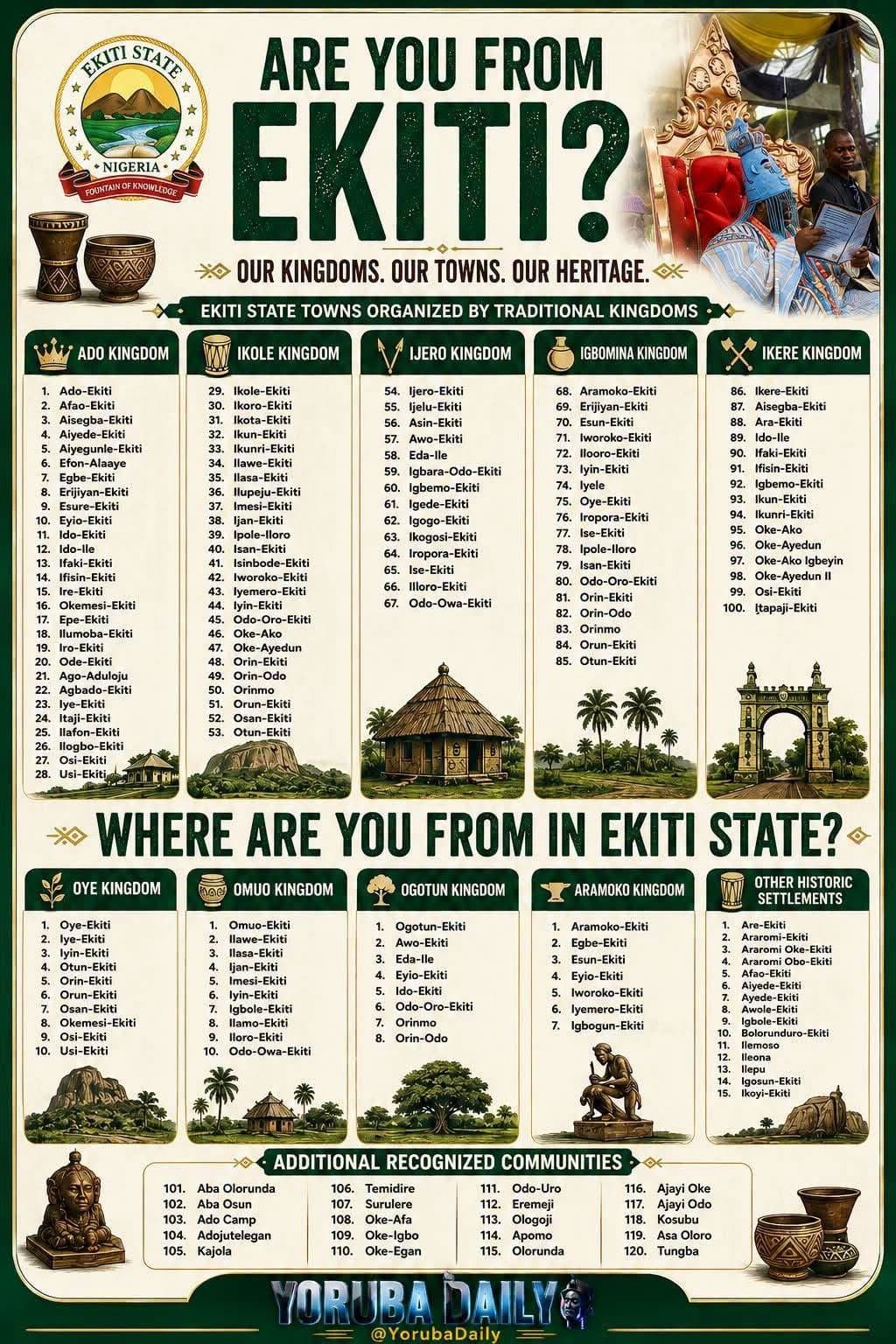
Quick Facts About Ekiti State
Ekiti State carries the nickname "Land of Honour & Integrity" and was created on 1 October 1996, carved out of the old Ondo State. The state covers an area of 6,353.2 square kilometres and lies at latitude 7°40' North and longitude 5°5' East, bordered by Kogi State to the north, Ondo State to the south and east, Kwara State to the west, and Osun State to the southwest.
With an estimated population of nearly 3.5 million as of 2022, Ekiti is the 31st largest Nigerian state by area and the 30th most populous. Despite its size, it is regarded as one of the smallest yet most educated states in Nigeria, boasting the highest number of professors nationwide - a distinction that reinforces its "Fountain of Knowledge" identity.
The Ekiti people are a distinct subgroup of the Yoruba ethnic group, widely known for their strong cultural heritage, hospitality, and deep-rooted emphasis on education.
A Brief History of the Ekiti People
The story of Ado-Ekiti, the state capital, stretches back centuries. The city was founded by Ewi Awamaro, son of Biritikolu, whose long migration took him from Ile-Ife through Ita Orogun and Oba-Ile before he eventually settled at Ilesun, present-day Ado-Ekiti. This traces the Ekiti people's origins to migrations from Ile-Ife, the cradle of Yoruba civilization, where settlers established towns across the hills and valleys of the region - a landscape that gave the area its name, with "Ekiti" believed to derive from "Okiti," meaning hill.
Ado-Ekiti's own origins trace back to the 12th century, and the city played a role in the historical Ife-Modakeke wars before later becoming a key town in the Ekiti-Parapo confederacy against the Oyo Empire.
Economy, Land and Resources
Ekiti's economy is primarily agrarian, with a large share of the population engaged in farming and agro-related work, growing crops such as yam, cassava, maize, rice, cocoa, oil palm, banana and citrus fruits. Roughly 75% of the state's workforce is engaged in agriculture, with cocoa, rice, kola nut and oil palm as the leading cash crops.
The state is also rich underground. Ekiti holds several untapped mineral resources, including cassiterite, columbite and tantalite found in Ijero-Ekiti; ceramic and kaolinitic clays in Isan-Ekiti and Oye LGA; feldspar in Oke Ewu (Ijero) and Aramoko; bauxite clay in Orin-Ekiti; and quartzite around Ijero and Efon-Alaaye. Dimension stones such as granite, charnockite and banded gneiss are also found extensively in Ikere-Ekiti, Ado-Ekiti, Oye-Ekiti, Ewu and Otun-Ekiti.
Culture, Festivals and Tourism
Ekiti's calendar is marked by vibrant traditional festivals that draw sons and daughters of the soil home each year. The Udiroko Festival in Ado-Ekiti and the Olosunta Festival in Ikere-Ekiti are among the most celebrated, showcasing the vibrant cultural spirit of the Ekiti people.
For visitors and residents alike, the state's natural landmarks remain a major draw - chief among them the Ikogosi Warm Springs and the Iworoko Mountain, alongside the scenic landscape around Ipole-Iloro.
Education and Healthcare
True to its "Fountain of Knowledge" reputation, Ekiti remains a trailblazer in education, with a high literacy rate and a large number of schools per capita, home to institutions such as Ekiti State University and the Federal Polytechnic, Ado-Ekiti, along with the Bamidele Olumilua University of Education in Ikere-Ekiti and the private Venite University in Iloro-Ekiti.
On the health front, while the state has made progress in basic healthcare delivery through primary health centres and general hospitals, there is a growing need for comprehensive healthcare reforms to meet modern standards, though the presence of the ABUAD Multi-System Hospital has significantly improved healthcare access in recent years.
Ado Kingdom
Ado Kingdom is home to the Ekiti State capital and remains the political and administrative heart of the state.
- Ado-Ekiti
- Afao-Ekiti
- Aisegba-Ekiti
- Aiyede-Ekiti
- Aiyegunle-Ekiti
- Efon-Alaaye
- Egbe-Ekiti
- Erijiyan-Ekiti
- Esure-Ekiti
- Eyio-Ekiti
- Ido-Ekiti
- Ido-Ile
- Ifaki-Ekiti
- Ifisin-Ekiti
- Ire-Ekiti
- Okemesi-Ekiti
- Epe-Ekiti
- Ilumoba-Ekiti
- Iro-Ekiti
- Ode-Ekiti
- Ago-Aduloju
- Agbado-Ekiti
- Iye-Ekiti
- Itaji-Ekiti
- Ilafon-Ekiti
- Ilogbo-Ekiti
- Osi-Ekiti
- Usi-Ekiti
Ikole Kingdom
Ikole Kingdom stretches across a large cluster of towns in the northern part of Ekiti State.